
Should I Let My 4-Year-Old Win? Keeping Games Fun With Dad
Your child cries when they lose. Should you let a 4-year-old win? Try fair adjustments, useful words, and three cooperative games to enjoy with Dad.
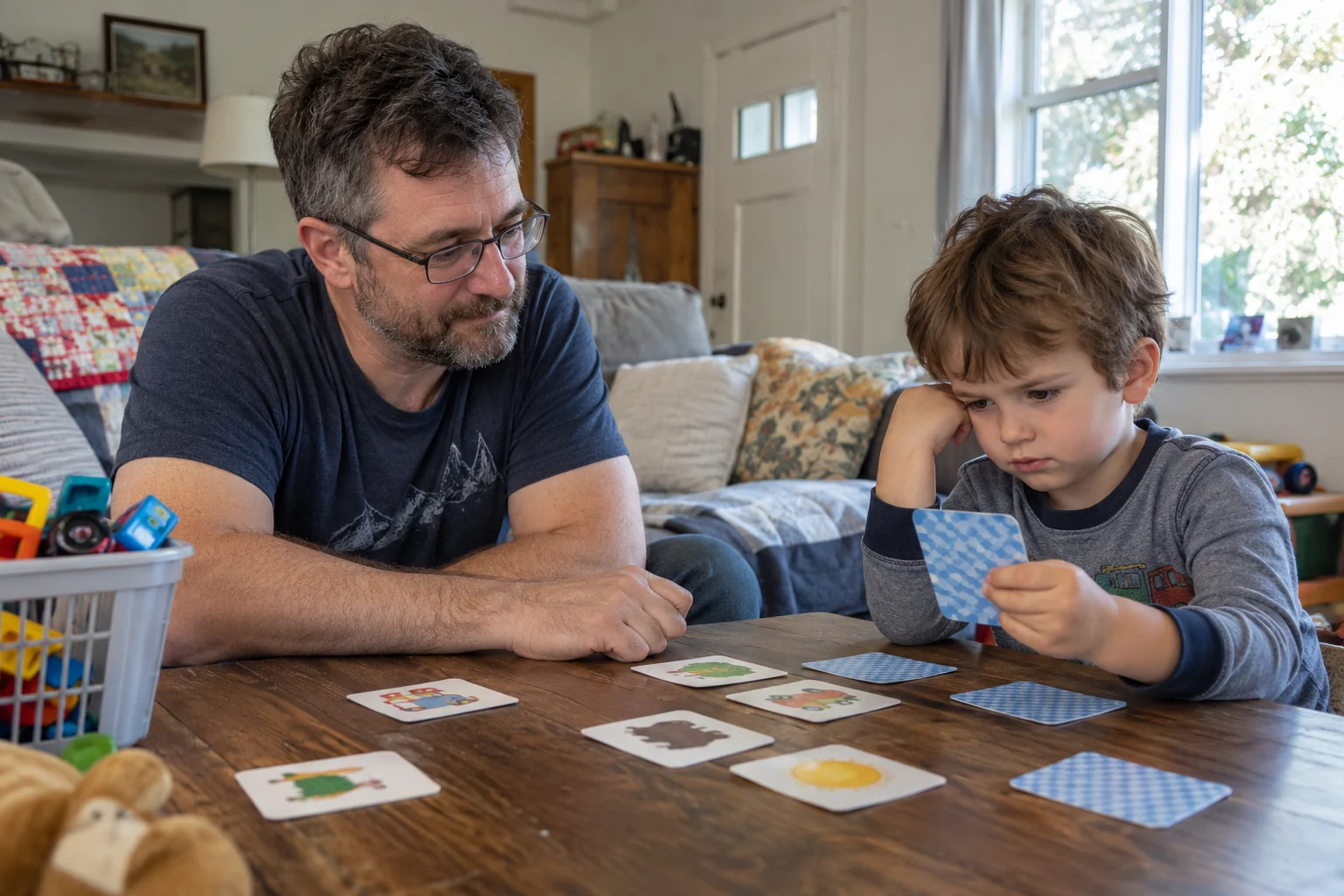
Choose a short game your child understands and adjust the difficulty before you start. Give them a fair chance to win, or play as a team. If losing brings tears, pause, name the disappointment and return when you are both ready.
The last matching pair is yours. Your child sweeps the cards off the table. You wanted ten pleasant minutes together; now you are wondering whether you should have let them win.
Look at the game before choosing the winner. Is it too long? Does your child understand what gives them a chance? Do you both still want to play? You can adjust the setup without turning every result into a test.
So, should you let your child win?
Sometimes. Deery, Harrison and Rowlings suggest adjusting the challenge and warn that an obviously handed-over victory can disappoint children. Start by making the game playable for both of you.
You can make your advantage smaller in a visible way. Your child throws from closer to the basket, for example, or you use fewer matching pairs. Explain the setup beforehand instead of changing a rule the moment they might lose.
Cooperative games are another good choice when you both want a calmer afternoon.
At 4, start with a game they can follow
Raising Children Network recommends age-appropriate games, simple rules, and short waits for younger children. How long a turn takes and how much each person can participate also affect enjoyment.
Demonstrate one turn: “Turn over two cards. If the pictures match, keep them. Otherwise, put them back. Then it’s my turn.” Try a practice round together without counting anyone’s pairs.
The Illinois Early Learning Project notes that preschoolers do not all understand winning and losing in the same way. Some are more interested in taking part. Notice what your child understands rather than assuming the intentions of an older player.
Three choices before the cards come out
- A short round: choose a game that can end while your child still wants to participate. Agree on one round, then see whether you want another.
- A known adjustment: fewer cards, a closer target, or one less rule, agreed before you start. Explain what stays the same for both players, too.
- A way to pause: “If this gets too frustrating, we can put the cards down and take a break.” A break does not need a threat that you will never play together again.
These are our examples of applying guidance on suitable games and clear rules. They do not guarantee that losing will feel easy.
What can you say when your child loses and cries?
Start with what happened: “You wanted to win. You’re disappointed.” Stay near without immediately producing another game or explaining how useful this loss will be.
If pieces start flying, move them away: “I’m keeping the cards here.” Help your child settle before talking about the result.
Offer something you can follow through on: “We can pack up, or try again later.” Finish if they have had enough. A good evening with Dad can continue with a book or building, even after a difficult game.
Dad can show what losing looks like, too
When you genuinely lose, keep your response ordinary: “I hoped I’d find that pair. You found it first. Well played.” You can be disappointed without a comic performance or pretending to be delighted.
Raising Children Network highlights that children watch how adults follow rules and respond to results. Avoid teasing when you win or insisting on a rematch when you lose.
Notice a specific action: “You waited for my turn even though you had already spotted the card.” That gives you something to appreciate beyond the final score.
Three games where you play on the same team
Find the pairs together
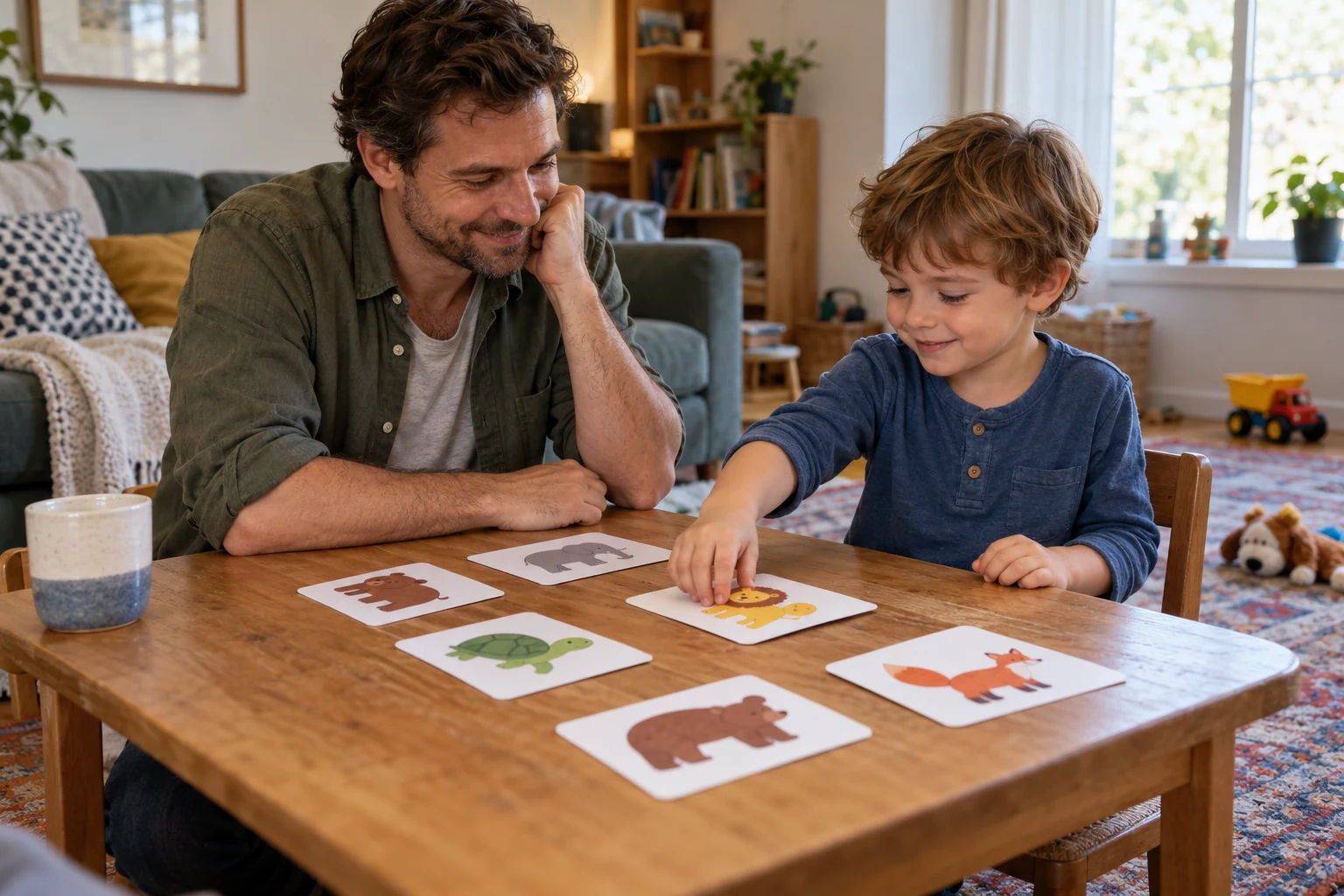
Set out a few large picture cards. Find the matches together, taking turns without separate piles. Your child can ask for help. Finish when the pairs are found, or when you want to stop.
Try, “We found both cats. Which animals are still here?” Adjust the number of cards to their interest rather than a level they must complete.
Build an animal bridge
Use large, age-appropriate blocks to build a bridge for two toy animals. One person adds a piece; the other suggests the next. If it falls, look together at how to rebuild it or change the game.
Neither player has lost against the other. You have a shared project and the attempts that come with it. Our low-energy games after work offer more ideas in the same spirit.
Fill the basket together
Put a basket on the floor and use a few rolled-up socks. Each person throws from a comfortable distance. Your shared aim is to get the socks inside, without a timer or competing scores.
If your child wants to carry them to the basket, accept that version or choose another activity. You are here to play together, not complete a throwing drill.
What if my child wants to win every time?
Acknowledge the wish without promising the result: “You’d like to win again. I don’t know who will win this time.” If they want to direct the whole story, try a pretend store or pirate game where inventing the rules is part of the fun.
If they move a piece straight to the finish, return to the agreed rule: “In this game, the die tells us how far to move. Would you like to keep playing that way or pack up?” Announce a changed version as a new game that both players agree on.
Does your child mainly want to move? Offer a physical game without a score. Our guide to roughhousing with Dad explains how to agree on boundaries and respect an immediate stop.
Questions dads ask
Should I tell them I let them win?
Avoid undoing their enjoyment with “I let you win.” Next time, make the adjustment visible from the start. Your child can understand that Dad throws from farther away without their success being a joke.
Will cooperative games prevent them from learning to lose?
They let you play without ranking yourselves against each other. Alternate kinds of games according to your child’s interest. None of the sources below establishes a number of losses a 4-year-old needs.
What if I am the one getting angry?
Pause and acknowledge your reaction. If you yelled, our guide to apologizing to your child offers ways to return to them. Later, choose a game you actually want to share.
How can I tell whether the game suits us?
Your child understands enough of the rules to take part, and you both find enjoyable moments during the game. If either of you dreads the next round, change the game, its length, or its difficulty.
If the next disagreement arrives when the game has to end, try our guide to helping a preschooler stop playing.
Sources and further reading
[1] Raising Children Network. Playing fair: tips for kids and parents.
[3] Illinois Early Learning Project. Learning Math Through Games.
General ideas for family life; seek individual professional advice for concerns about your child.