
Too Tired to Play After Work? 7 Low-Energy Games for Dads and Preschoolers
Too tired to play with your kids after work? Try seven simple games for ages 3 to 5, with little setup, seated options, and easy ways to join in.
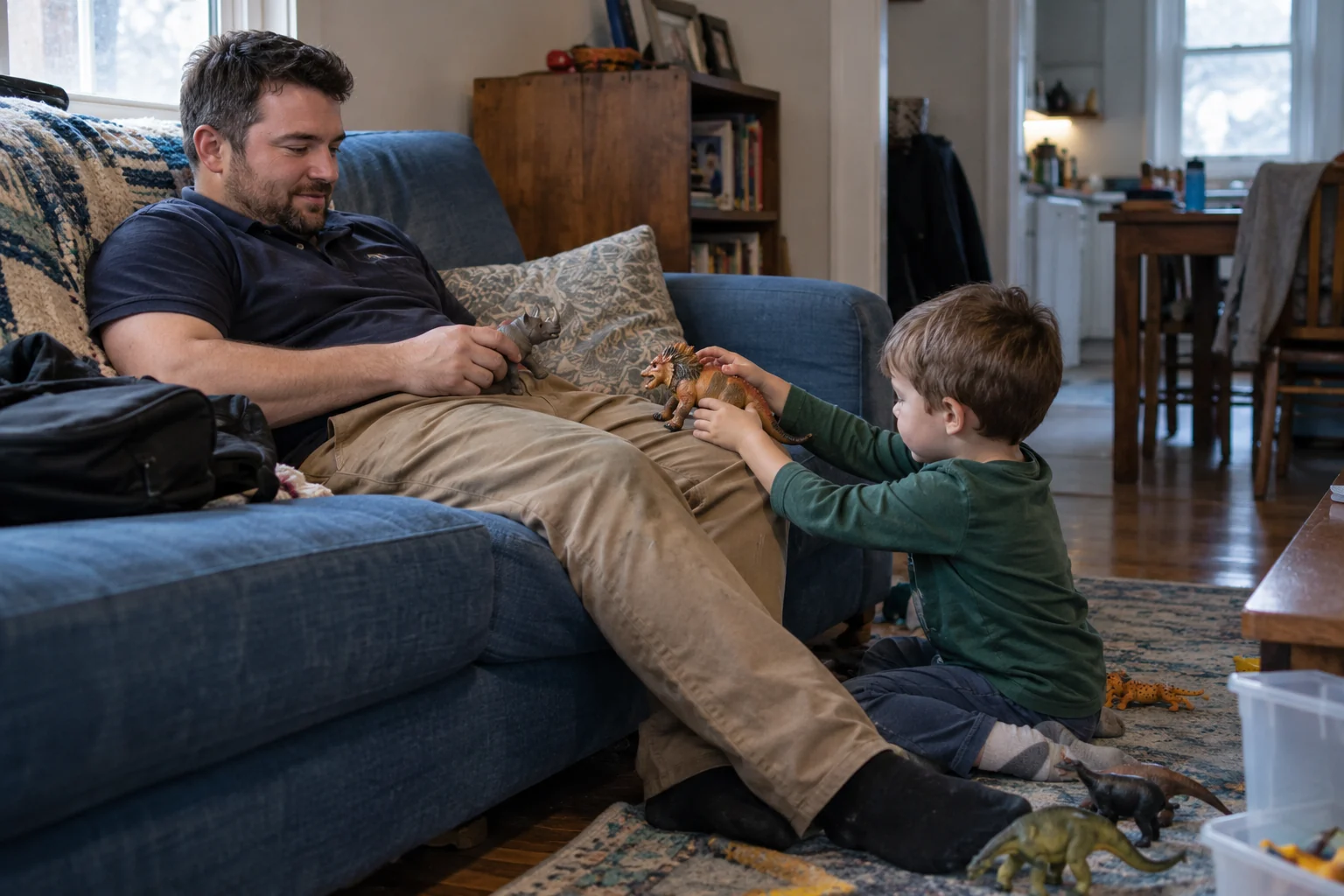
You have made it through work and the journey home. Your child has saved all their energy for you. A chase around the sofa sounds impossible. Buying a pretend banana? That you can manage.
Take the seated role: shop customer, patient, storyteller or building assistant. Put your phone away, tell your child how long you can join in, and let them set the scene. You can play a very convincing customer from the couch.
You can still be the customer. Sit down, order something strange, and see what arrives. The useful question is which part of the game you can join with the energy you actually have.
Start small, and tell your child what is happening
If you need a transition after work, make it concrete: “I’m changing and getting some water. After that, I can play cars until dinner.” Avoid “later” when you already know it will keep moving.
Put your phone out of reach and follow what your child is doing. The CDC suggests starting with at least five minutes of child-led play and building gradually. Choose a stretch you can give your attention to tonight.
Child-led play means your child has room to choose what happens and you respond. If the tower becomes a garage, follow the new idea. When you spend the whole time directing, correcting, or asking test questions, you leave less room for their contribution.
For these games, choose age-appropriate toys and stay awake and involved. If you are close to falling asleep, arrange supervision first. None requires your child to climb on you or play out of sight.
7 low-energy games to play after work
1. The Very Silly Shop
You need: a few safe objects or toy groceries. Your child opens a shop beside your chair. You are a customer with an unusual order: “Do you have a banana for a very small dinosaur?” Accept the substitute they offer and let them decide what it costs in pretend money.
Your part is to respond to their ideas. If they hand you a block, you might say, “Excellent. A crunchy banana.” Let them decide whether to keep the joke going. Stop after one last order, announced before you make it.
What you are sharing: pretend roles and a conversation that takes turns. For a younger child, simply buying what they offer is enough; the absurd order is optional.
2. Build It, Tell Me
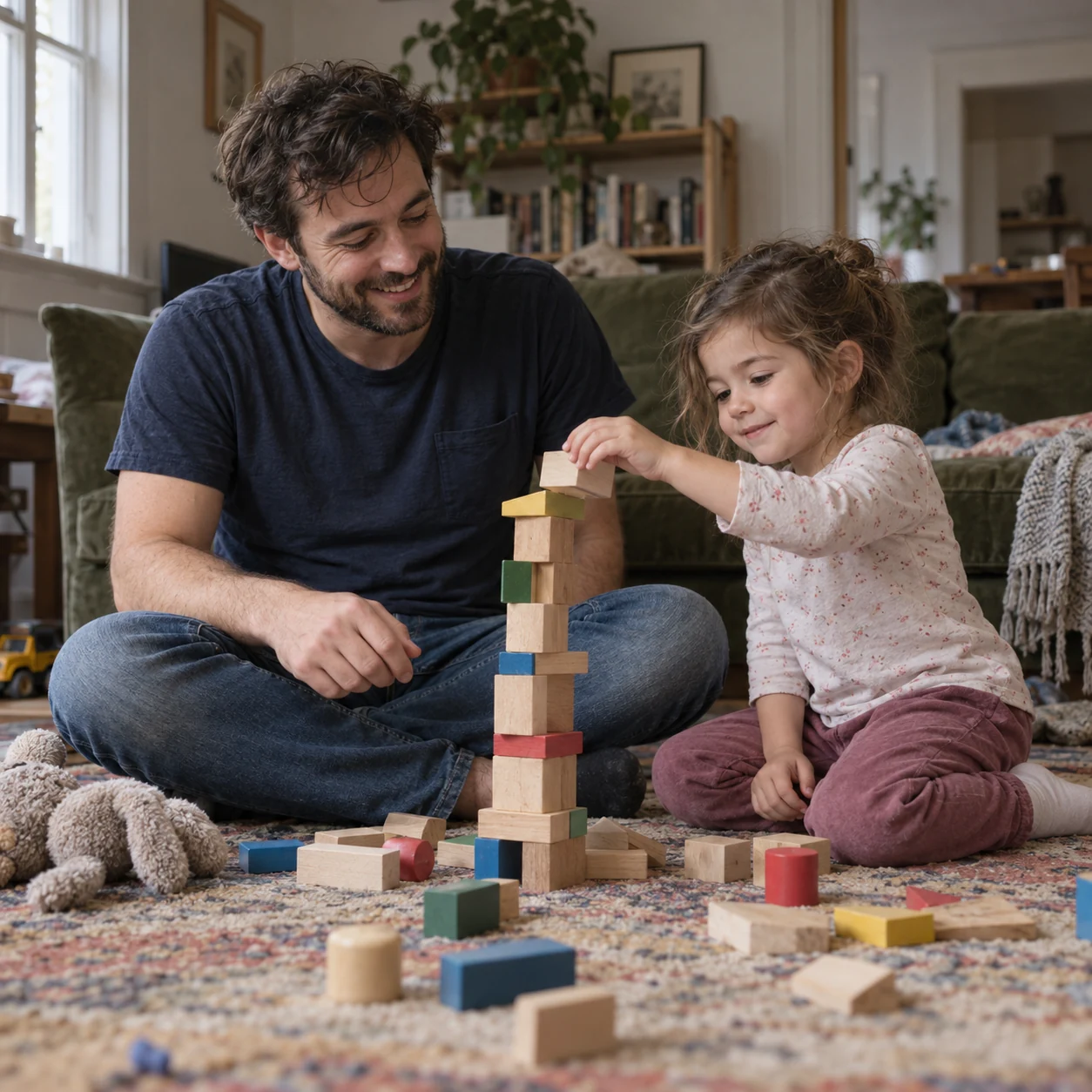
You need: blocks, with both of you seated at a table or on the floor. Let your child decide what to build while you place a few pieces alongside them. Describe something specific: “That bridge reaches all the way to the red tower.”
Leave room for their explanation rather than testing colors or counting every block. If they invite you to build, ask where your piece belongs. The building can continue after your shared turn ends.
What you are sharing: describing an idea and building alongside each other. Your child might place a few blocks or explain a whole city. Follow what they are trying to do and offer help if they need it.
3. The Stuffed-Animal Waiting Room
You need: two or three stuffed animals. Your child decides why the animals have come to visit. You voice one patient: “My ears keep hearing the refrigerator. Is that normal for a rabbit?”
Let your child invent the checkup or change the game completely. No medical kit is needed. A teddy waiting quietly for its turn is enough to start a conversation.
What you are sharing: make-believe caregiving. You can wonder aloud about the toy’s feelings, but do not use its story to diagnose your child or press them to reveal a worry.
4. Draw One, Add One
You need: paper and age-appropriate crayons. Draw a small shape, then invite your child to add something. Your circle might become a wheel, a face, or an animal. Add another mark in response.
If your child wants a page of their own, draw beside them instead. There is no finished picture to aim for and no need to correct the story they give it.
What you are sharing: taking turns adding to an idea. Ask before drawing on their work. If they want to keep their picture untouched, use a separate sheet.
5. The Toy Radio Show
You need: one toy your child likes. Hold an imaginary microphone and let the toy report the news: “A truck has parked inside a slipper. Can you tell us what happened?” Your child can answer, make sound effects, or move the toy.
Switch roles if they want the microphone. Keep it to one short report if that is all you have in you. A repeat broadcast tomorrow can become part of the joke.
What you are sharing: telling and responding to a story. Your child can use a noise or a gesture instead of a full answer. Pause long enough for them to contribute.
6. The Missing Toy Detective
You need: three familiar toys on a table. Look at them together, cover them with a cloth, and remove one while your child looks away. Uncover the others and investigate what is missing.
Then let your child hide one for you. Keep everything within reach and use fewer objects if three feels frustrating. You are solving a small mystery together, not testing memory.
What you are sharing: remembering together and swapping roles. Let your child look again or show you the answer. Make it easier as soon as the puzzle stops being fun.
7. The Story Soundtrack
You need: a picture book. Read while your child chooses a sound for one character or event. Each time the truck appears, pause for their engine noise. They can also point, turn the page, or listen.
For bedtime, choose quiet sounds and keep the story calm. The Little Night Noise gives you a short adventure to read together, with a choice your child can help make.
What you are sharing: listening and joining a story. Offer a repeated sound or a page to point at; participation can be quieter than answering questions.
Why these games can be useful, even when you are seated
Notice a detail, respond, then leave a gap. Harvard’s Center on the Developing Child describes responsive back-and-forth interaction as “serve and return.” The principle is the exchange between you, not the number of props or how loudly you perform.
If your child says, “The shop is closed,” you could answer, “Closed already? I’ll come back when you open.” You are showing that you heard their idea. You do not have to turn it into a lesson about business hours.
The American Academy of Pediatrics’ report The Power of Play describes play as an opportunity for language, social interaction, and self-regulation. Here, the games give you ordinary ways to practice those exchanges together. They are invitations, with no score or developmental milestone to reach.
Clinical psychologist Stephanie Samar, PsyD, also highlights regular child-chosen time in Child Mind Institute guidance. Positive time together should remain available after a hard day; it need not be earned through perfect behavior.
What if your child wants running, chasing, or wrestling?
“My legs need a rest. I can do the shop or draw with you.” Make a clear offer and let your child decide whether to join.
Quiet games are one part of the day. They do not replace movement, outdoor time, or active play. When you have more energy, make room for a different kind of time together. If another caregiver is available tonight, agree on the handoff rather than assuming they will take over.
End the game without an accidental promise
Give an ending your child can picture: “One more customer, then I’m making dinner.” Finish that turn and acknowledge the wish for more: “You wanted to keep going. We can leave your shop here.” Only promise another session if you expect to keep it.
If you regularly have no energy for the things you usually enjoy, look beyond finding a cleverer game. Consider what rest or support you can arrange, and speak with a health professional if ongoing exhaustion is worrying you.
If you are unsure what to say in character, our guide to joining pretend play offers simple opening lines. As bedtime approaches, try the quieter steps in our guide to bedtime with Dad.
On a day when you both want to move, read our guide to roughhousing and knowing when to stop.
If the result takes over the game, read about playing with a child who finds losing difficult for simple rules and ways to play on the same team.
Found a game you both enjoy? You could keep a small place for it in your week. Our rituals for building your bond with your child explain how to choose something that fits everyday life.
Common questions
Is five minutes of play enough?
Start there if that is what you can manage. Keep making room for meals, conversation, care and longer play together too.
Can I play from the couch?
Yes, if you can stay awake, supervise, and take part. Keep toys and the play area within reach. Choose a seated game instead of using your body as climbing equipment.
What if I do not enjoy pretend play?
Try blocks, a shared drawing, or the missing-toy game. You can follow your child’s ideas without inventing a cast of characters. Start with something you can honestly enjoy a little.
What if my child refuses every suggestion?
Ask to watch what they are already doing, or offer company without a game: “I can sit with you while you build.” If they want space, respect that and look for another moment.
Have a longer window together? Try our 12 dad-and-child activities for ages 3–5, with options for home and outdoors.
On a day with more energy, try making a snack together. The upcoming Dad & Me cookbook is being developed for ages 4–7, with 30 recipes and a job for each of you. See the cookbook and join the updates list.
Sources and further reading
[1] CDC, Tips for Child-led Play. Supports short, regular child-led play, noticing and describing, and age-appropriate materials. Its initial five-minute suggestion is not a universal sufficiency threshold.
[2] Harvard Center on the Developing Child, Serve and Return. Explains responsive exchanges between young children and caregivers.
[3] Yogman M, Garner A, Hutchinson J, Hirsh-Pasek K, Golinkoff RM, et al. The Power of Play: A Pediatric Role in Enhancing Development in Young Children. Pediatrics. 2018;142(3):e20182058. DOI: 10.1542/peds.2018-2058. An American Academy of Pediatrics clinical report synthesizing research, not a trial of these seven games.
[4] Child Mind Institute, How to Help Children Calm Down, written by Caroline Miller with clinical experts Lindsey Giller, PsyD, and Stephanie Samar, PsyD. Includes guidance on clear expectations, transitions, validation, and regular child-chosen time.
General ideas for family life; seek individual professional advice for concerns about your child.