
Dad, What Can We Do? 12 One-on-One Activities for Ages 3–5
Looking for things to do alone with your preschooler? Try 12 dad-and-child activities at home and outdoors, with simple ways to join in and little setup.
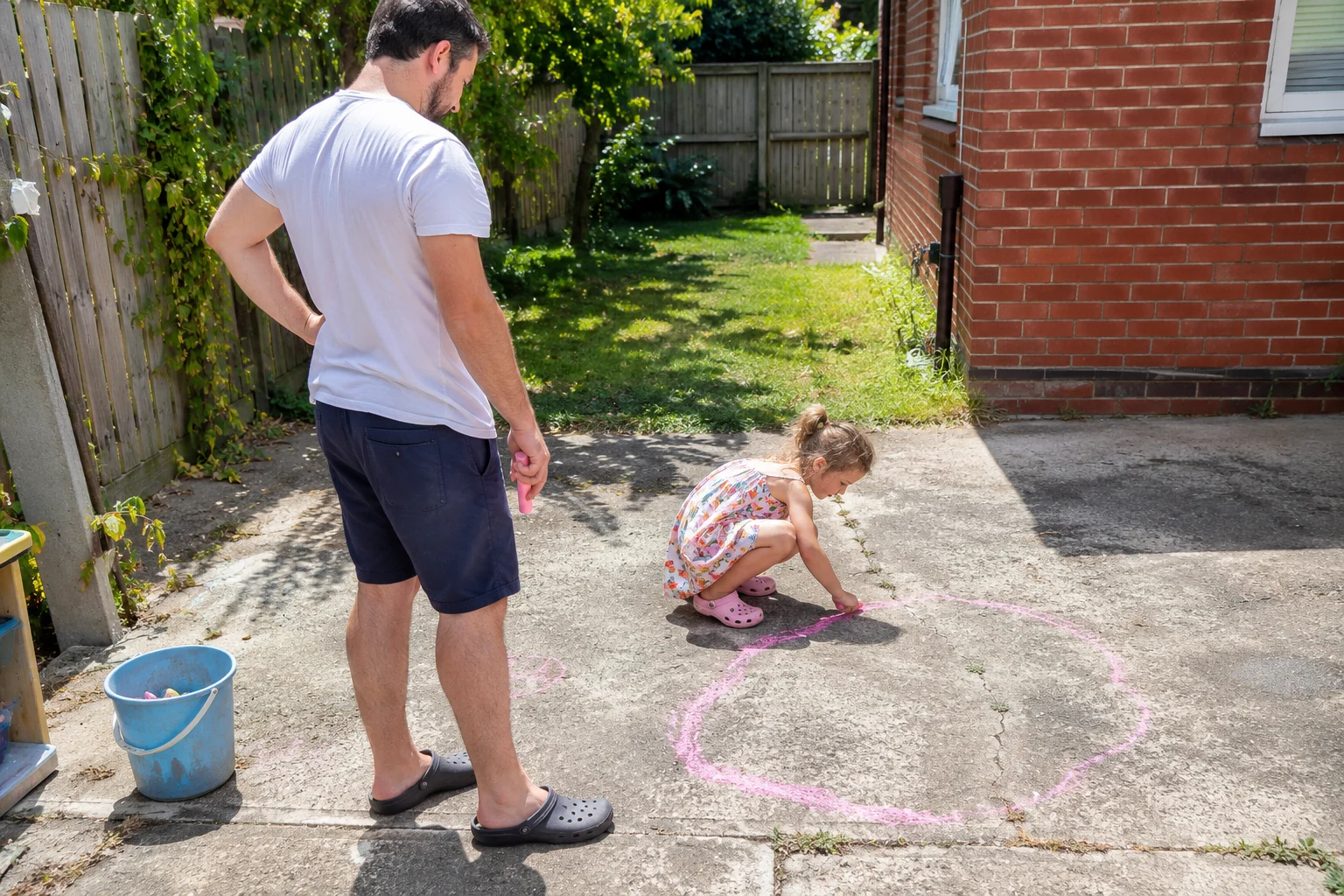
“Dad, what can we do?” You have twenty minutes before lunch and nothing planned. Open the kitchen drawer, look at the books or head outside. There is plenty to start with.
Start with the time and energy you have: make a snack, build a ramp, visit the library or take a short walk. Give your child something to choose and a real part to play. The twelve ideas below work with everyday materials.
Some of these ideas fit before lunch; others can fill a morning. Pick one for the energy you both have today.
For a first full day together, our guide to a day alone with your preschooler covers planning, meals, rest and requests for the other parent.
For a walk you can start from home, these seven walking games for dads and preschoolers give you a small shared mission, a story or something to notice together.
Before choosing an activity, give your child a part in it
Offer two options you are happy to do: “Shall we look at books at the library or build a house for your animals?” Once you begin, notice what holds their attention. If your garage becomes a dinosaur hospital, you could be the person checking in patients.
The CDC encourages following your child’s lead, describing what they do and giving fewer directions during play. Keep safety limits clear.
For an outing, plan for toilets, water, a suitable snack and getting home. As the only adult, choosing somewhere manageable gives you more attention to spare for your child. A longer trip can wait for another day.
What makes the time feel shared?
The Center on the Developing Child at Harvard describes back-and-forth exchanges in which an adult notices a child’s initiative, responds and leaves time for a reply. Here is how that can look on a walk.
Your child stops beside a leaf with holes in it. Move closer: “You’re looking at the little holes.” Wait. They point to another hole and say a monster ate the leaf. You can follow their idea: “A very tiny monster?” Now you have a shared subject that came from them. If they watch without talking, you can simply watch alongside them.
There is room to explain something you know or ask a genuine question. Leave space for their words and gestures rather than running through questions whose answers you already know. Remember what caught their interest; you will have a starting point for your next time together.
Six dad-and-child activities at home

1. Build a den your child can make their own
Use a light sheet, a sturdy table and cushions on the floor to make somewhere you can both sit. Your child chooses what goes inside: a book, a stuffed animal, an imaginary front door. Avoid climbing structures and keep the entrance clear.
Ask where you can sit, then join their story. “Do I need a ticket to come in? Where do I get one?” If your child simply wants to look at a book inside, the den is already doing its job.
2. Open a toy repair shop
Put two or three sturdy, large toys on a towel. Your child can inspect them, wipe them with a cloth and decide which are ready to go. Keep real repair tools, batteries and loose parts out of reach.
Be the customer describing the problem: “My truck makes a strange noise when it turns. Could you take a look?” Let your child invent the diagnosis, even if the prescribed repair is a nap for the truck.
3. Make your afternoon snack together
Choose something with a task your child can take on: stirring yogurt, spreading a topping with a suitable utensil or arranging fruit you have safely prepared. Check allergies and choking risks, and stay alongside them.
Let them own one step rather than moving their hands through each action. Our guide to cooking with your preschooler has more tasks and practical safety precautions.
4. Take turns adding to one drawing
Draw a simple shape on a large sheet of paper. Your child changes it; you add something to their contribution. A circle becomes a wheel, then the wheel belongs to a vehicle that carries strawberries.
Follow the drawing instead of correcting it. “You put a door at the top. I’ll add some stairs.” Use age-appropriate drawing materials, and let a few marks be enough if your child wants to move on.
5. Run a stuffed-animal café
Bring out two unbreakable bowls, some large stuffed animals and a spoon. Ask what is on the menu. You can order, wait, swap roles and find out why the rabbit must be served before everyone else.
If joining an imaginary game feels awkward, our guide to playing pretend with your preschooler offers ways to take part without taking over.
6. Record a two-minute radio show
With your phone in airplane mode, record your voices if your child wants to. Report the living-room weather, make animal noises or tell a short story. Listen back together, then put the phone away.
Hearing their own voice and seeing your reaction may be the part they enjoy most. Keep the recording private. If they prefer not to speak, you can present while they choose the sound effects.
Six outings with Dad that need very little planning
7. Look for three things on a walk
On a familiar, safe path, look for something round, something moving and something making a noise. Share your own discovery: “I found the bicycle’s shadow. It’s moving along with us.”
Allow the walk to slow down. You do not have to find everything. Observe unfamiliar plants and objects without picking them up, and keep clear of traffic and water.
8. Choose a library book each
Check the opening times, then explore the children’s area together. Your child chooses one book and you choose another. Look at a few pages, talk about a picture, try a voice or revisit a favorite part.
If your child picks the same book again, you can read it again. Your choice is an invitation to discover something together, not a requirement to finish two books before leaving.
9. Give a small shopping trip a purpose
Go to choose the fruit for your snack, for example. You handle the budget, payment and safety. Your child can spot the stall and choose between two suitable options.
Prepare and share what you bought when you get home. An ordinary errand now includes a contribution your child made. Try to keep the trip small if your intention was to spend time together.
10. Draw a map of the park
In a suitable park, sketch a simple map together: the entrance, a tree, a bench. Your child adds things they notice as you move around. At 3, a few marks accompanied by their explanation are plenty.
Be the explorer who follows their directions while keeping to safe boundaries. If they would rather head for the swings, the map can wait until you get home.
11. Take your snack somewhere nearby
A quiet bench or a blanket in a safe spot is enough. Bring suitable food, water and a way to clean your hands. Sit down to eat together and supervise your child.
Tell them a small story from your childhood or listen to what they notice around you. Silence is fine too. You can share this time without turning it into an interview about their day.
12. Photograph your neighborhood at child height
Let your child choose three things to photograph: a doorway, a tree, an unusual shape. Take the pictures yourself or help them handle the camera safely, putting it away between shots. Respect other people’s privacy.
At home, look at the three pictures and let your child name them. You might see a familiar route differently. If the phone becomes the whole activity, look for the three things without photographing them.
How do you adapt these ideas from age 3 to 5?
With a 3-year-old, try a simple start: a small amount of material and one action you demonstrate. At 4 or 5, your child may want to invent roles or plan what happens next. Their interests, communication and energy matter more than a time limit based on their birthday. These are practical adaptations, not required developmental steps.
If your own energy is low, start with a drawing or a book. For a short window after work, see our low-energy games for tired dads.
What if your child isn’t interested?
“Would you like help getting started, or shall we put this away?” Try fewer materials, a different place or a game already underway.
Hunger, tiredness and wanting to play alone also matter. You can stay available without filling every minute. Sesame Workshop encourages dads to use ordinary moments as opportunities for attentive time together.
If you choose a game with a winner, adjust the challenge and number of rounds too. Our guide to whether you should let your child win explains how to keep playing enjoyable when losing feels difficult.
When the plan needs changing
Do I need to plan a whole day?
Start with one activity and keep familiar meals and rest times. If you have a full day, a simple morning outing followed by free time gives you a flexible shape. Explain the main steps without promising a packed schedule.
Are these activities for daughters or sons?
Choose around your child’s interests: building, drawing, moving, cooking or playing roles. All these ideas can work for girls and boys. Offer something new occasionally, too, without making it a test.
How can we make one of these our regular thing?
If you both want to do it again, keep a familiar detail: the starting point of your walk, choosing a snack together or your Saturday radio show. Our guide to dad-and-child rituals explains how to keep a shared tradition manageable.
Want cooking to become a regular activity? Explore the upcoming Dad & Me cookbook: 30 recipes planned for dads and children ages 4–7. See the cookbook and join the updates list.
For a first snack together, try our five no-cook recipes to make with your child. Choose one preparation and give each of you a job.
Sources and further reading
Sesame Workshop — Little Moments, advice for dads with young children
Harvard University, Center on the Developing Child — 5 Steps for Brain-Building Serve and Return
General ideas for family life; seek individual professional advice for concerns about your child.