
7 Walking Games for Dads and Preschoolers, With No Equipment
Make a short walk more fun with seven dad-and-child games for ages 3–5. Try listening, guessing and pretend play, with simple ways to adapt each idea.
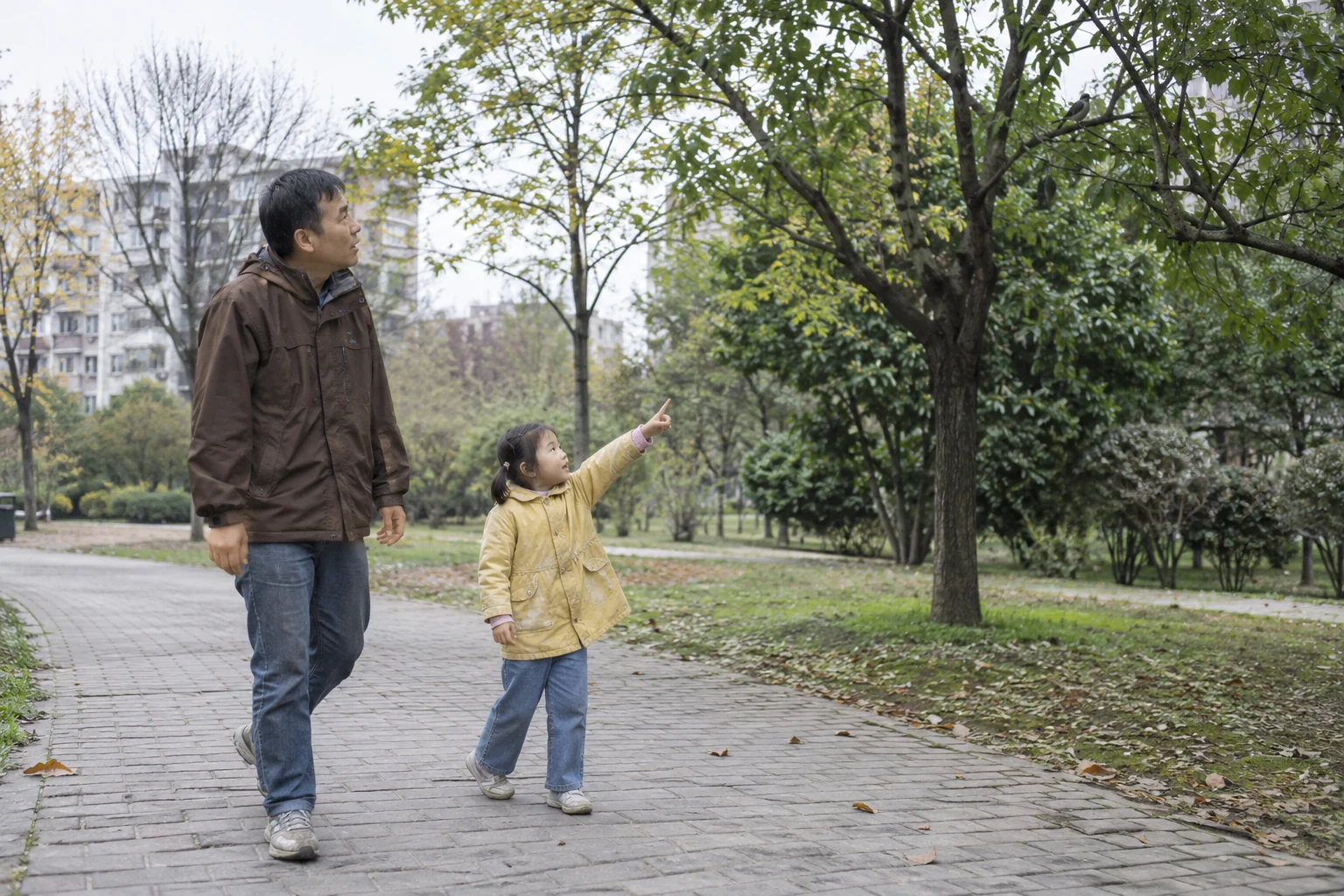
You have barely left home and your child asks to be carried. Check whether they need a rest or a shorter route first. If they feel comfortable but the walk has little appeal, try giving it a purpose: “We have an invisible parcel. Who lives at the next tree?”
Choose one game for a familiar walking route: carry an imaginary parcel, listen for three sounds or let your child give the tour. Pause the game at crossings and keep attention on the road. A short loop is enough.
These walking games are for dads with children ages 3 to 5. Choose one that fits today. They work on an ordinary neighborhood path; you do not need a forest or a long route. You can also play several from a bench or while accompanying a child in a stroller or wheelchair.
Before you start: choose the route and pause at crossings
Keep the route short enough to get home comfortably. Account for the weather, water, toilets and how you will return if your child gets tired. A game will not replace a rest or make a too-long walk suitable.
Use a safe walking path and stay responsible for traffic, driveways, bikes, animals and other hazards. Stop the game when you need your full attention, especially before crossing a road, and hold your young child’s hand at crossings. These are adult decisions even when your child is “the guide.” AAP pedestrian guidance emphasizes adult accompaniment, safe routes and avoiding distraction.
The games below are suggestions to adapt to your child. Choose one, leave the others for another day and follow what catches their interest.
1. Deliver an invisible parcel
Choose a visible destination on your safe route, such as a bench in the park. “This parcel is for the duck who lives by that bench. What do you think is inside?” Cup your hands around an imaginary box, then let your child decide how big it is and who should carry it.
On the way, discover a problem together: perhaps the parcel is making a tiny snoring sound. Your child can decide whether it contains a sleepy sock or a very small dragon. At the bench, pretend to set it down and finish the delivery. Keep real birds and other animals out of the game; the recipient is imaginary.
For a child who wants fewer words, offer two choices: “A tiny box or a huge box?” If they want more story, let them invent what the recipient says. Our guide to pretend play offers other ways to take a supporting role.
2. Bring three sounds home in your memory
Stop somewhere safe and listen with eyes open. Find one sound each: a bird, a gate clicking or shoes on gravel. Imitate them quietly, then see whether you can remember the sequence at the next stop. You can get it wrong on purpose and let your child correct you if they enjoy that.
Use fewer sounds if three is too much. Pointing toward a sound is enough; naming its source is optional. Keep the game separate from checking whether the road is clear: a quiet road can still have vehicles on it. For another listening activity at home, try The Little Night Noise and its sound hunt.
3. Find a shape in two surprising places
Pick something you can both see, such as the circle of a bicycle wheel. “Can we spot another circle?” Stop to look at an object on your route, without approaching traffic or touching somebody else’s property. Your child might notice the center of a flower or a round window.
If the shape word is unfamiliar, show it with your hands or say, “Another one shaped like this.” For a child who wants a harder clue, describe part of the object instead of naming it. Take turns finding something for the other person to guess; there is no score.
4. Let your child give Dad the tour
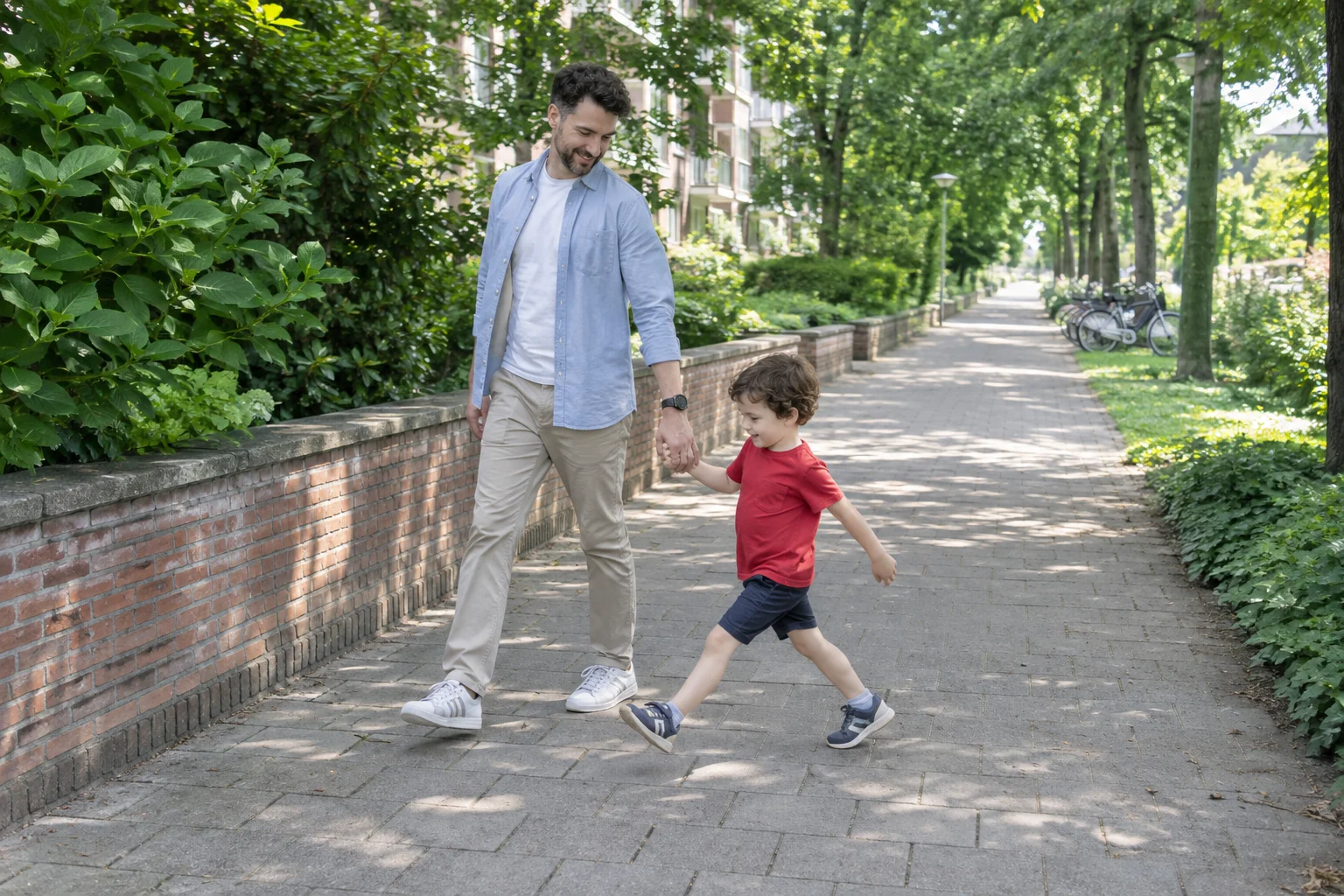
Choose a small, safe area with a clear boundary. “You’re showing me around this garden. What should I see first?” Follow to the flower bed or the unusual stone they choose. Stay responsible for where you can go and stop before any unsafe direction.
Let your child invent a name for a landmark: “The giant’s chair” might be a bench you have passed many times. Ask once what makes it a giant’s chair, or add your own observation. A child who does not want to explain can simply point and lead you to the next stop.
5. Invent a shop for something ridiculous
At a safe stop, imagine a shop in a cloud, a tree or a patch of sky. “That one sells spare tails for dinosaurs. What does yours sell?” Be the customer: “Do you have one that fits a very small dinosaur?” Let your child decide what is in stock.
You do not have to keep talking while you walk. One short exchange can last until the next stop. If your child prefers real things, switch to choosing which fruit you would buy at a market or what snack to make at home. You can follow up with our preschool kitchen tasks.
6. Tell the next bit of an adventure
Start with one concrete sentence: “A little bear came out to find his missing boot.” Let something on the route suggest the next bit: “He looked behind that tree…” Pause for your child to add a word, a sound or an action. You can carry more of the story if they prefer to listen.
Keep the problem small and playful. The missing boot could be full of flowers, not in a frightening place. If your child says the story is finished, accept that ending. If a passing bus becomes more interesting, you can leave the bear for another day.
7. Check on your usual spot
Choose a place you can safely see again on another walk: a tree on the public path, a flower bed or a bench beside a hedge. Look at one detail today. “That branch has one yellow leaf left. Do you think it will still be there next time?”
On the next visit, look together. You can be wrong about the leaf and curious about what happened. Leave plants, wildlife and unknown objects undisturbed; you do not need to collect anything. This gives you a little shared history to return to. Our dad-and-child rituals guide has more ideas for repeatable moments.
What if your child does not want to play or walk anymore?
Offer a game once and see whether it catches their interest. A child who wants to talk about a real dog may not want an invisible parcel. Follow the dog conversation from a safe distance, or walk quietly. You can share the outing without filling every minute.
If they stop walking, check what is happening before proposing a new mission. They may be tired, uncomfortable, hungry or finding the surroundings too much. Take a break or shorten the route. If the difficulty is repeatedly getting a no when you join in, our guide to a child who won’t play with Dad looks at ways to offer company without pressing.
Pick the easiest game for your next short walk. If your child asks to deliver another invisible parcel tomorrow, you already know what to try.
Sources and further reading
General ideas for family life; seek individual professional advice for concerns about your child.