
Roughhousing With Your Preschooler: How to Keep It Fun and Know When to Stop
Chasing, pretend monsters, and play fighting: how to roughhouse with your 3–5-year-old, notice discomfort, respect stop, and bring the game to an end.
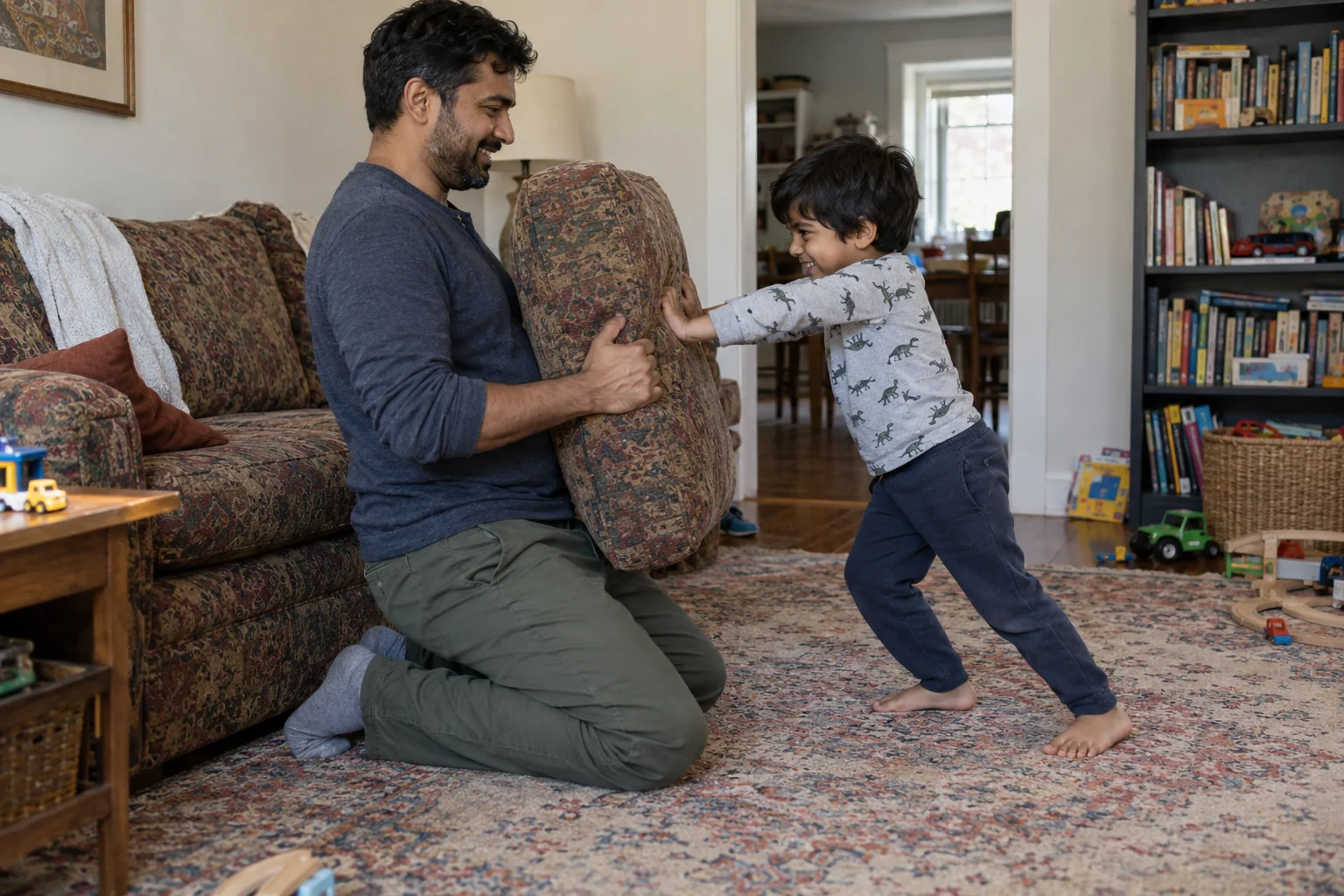
Keep physical play gentle and close to the floor, with space around you. Agree on a stop word, pause often and stop immediately when either person pulls away or says enough. Leave out head impacts, throws, pinning and neck pressure.
The cushion monster is a hit. Your child charges back, laughing, then suddenly goes quiet. Stop there. In a physical game, watching their face matters as much as hearing their words.
To keep it enjoyable, you manage the pace and respect every request to stop. Here are three ideas to play together, with ways to notice when it is time to slow down.
Roughhousing, play fighting, or an actual fight?
Roughhousing includes chasing, rolling around, and playful physical tussles. Raising Children Network distinguishes it from fighting by shared enjoyment and the absence of force or intimidation. Fear, tears, or anger mean interrupting the game.
Notice whether your child can move away, change roles, or decline a turn. They do not have to prove they are brave to keep playing with you.
Agree on the rules before starting
- Check that both people want this game: “Would you like a chase, or something else?” Your child can dislike chasing while enjoying other active games.
- Clear a floor-level space well away from stairs, sharp furniture and breakable objects. Keep the game small enough for that space.
- Stop at “stop,” and also when someone looks uncomfortable. Agree on a simple gesture as well as a word if useful. Practice a small stop-and-release before the actual game.
- Keep heads and necks out of holds. No hitting, biting, shaking, or pinning. Do not put your weight on your child.
These practical rules apply Raising Children Network’s guidance on respecting limits and stopping when the game is no longer welcome to everyone.
Three ways to begin gently
The walking monster
In a clear space, walk slowly with a monster voice your child enjoys. They can move away without being caught. If they return, see whether they want another pass.
Pause in your usual voice: “More monster, or something different?” Stop if they tense up or try to escape.
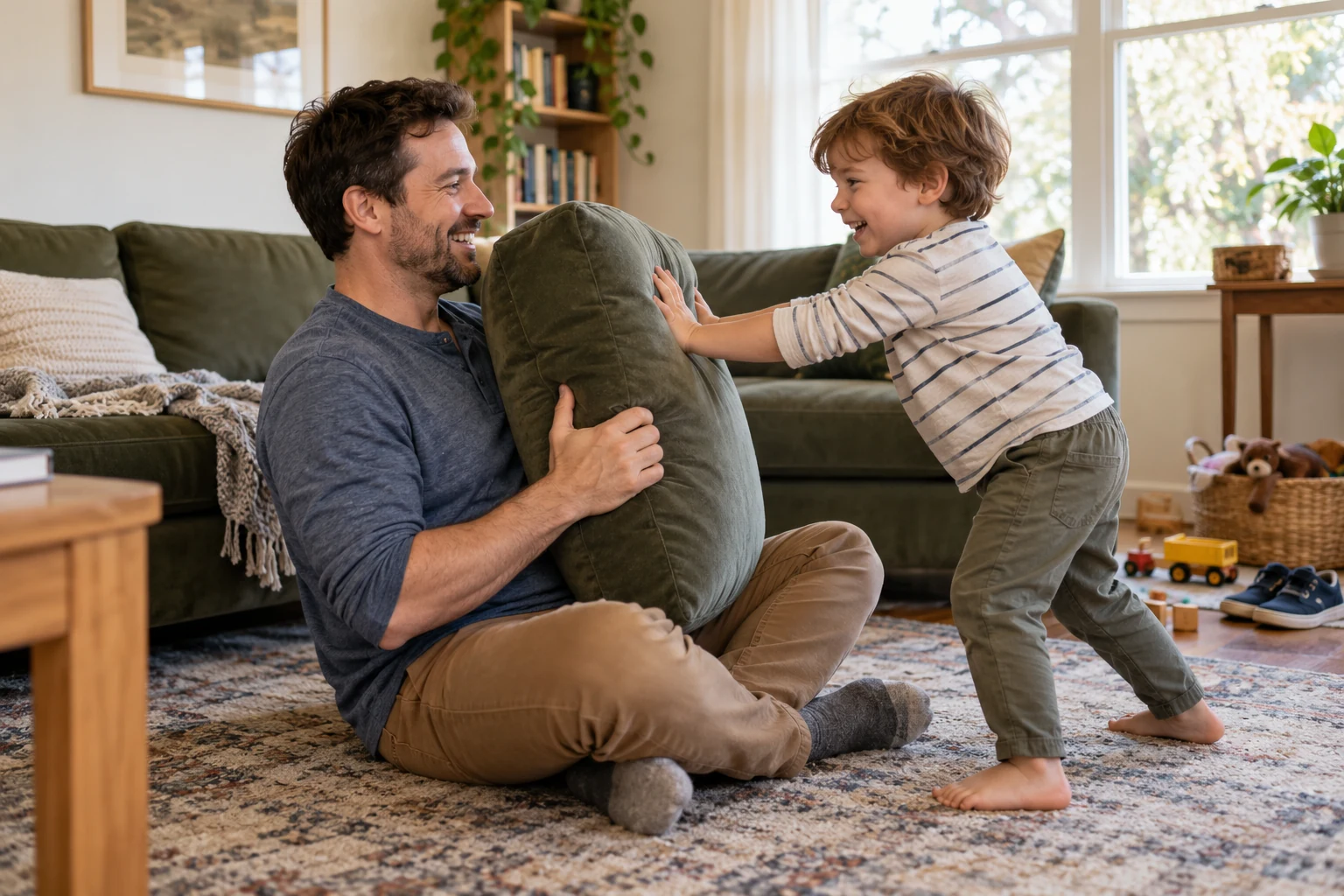
Push Dad’s cushion
Sit steadily on the floor and hold a large cushion in front of you. Your child can push it with their hands without charging into you. Let the cushion move back gently, then pause.
Keep it away from faces. If the game turns into jumping, hitting, or taking a running start, stop and choose a calmer version. Nothing should be able to topple onto your child.
Dance and freeze
Choose a rhythm and move beside each other without pulling on arms. One person says “statue,” and both stop. Your child can choose a pose, then you continue when they are ready.
Nobody needs to win. If they would rather dance without freezing, simply dance. Active time together can work without wrestling or chasing.
Laughter is not permission to keep going
During tickling, your child can laugh and ask you to stop at the same time. Follow the stop signal. Do not finish “just one more” or make them prove that they mean it.
If speaking is difficult for your child, pay even closer attention to their body and face. Pause often and let them choose to return. Silence is not a reason to restart.
You can stop, too: “That hurts. I’m moving back.” You are showing a boundary they can use as well. If hitting continues after the game ends, keep some distance and say, “That hurts. We’re stopping the game.”
Moves to leave out
Do not lift your child by the hands or wrists, or swing them by their arms. The American Academy of Orthopaedic Surgeons explains that pulling this way can cause a young child’s elbow injury known as nursemaid’s elbow.
Also leave out tossing children into the air, pinning, shaking, and jumping from furniture. These games do not require wrestling holds. Stop if you can no longer manage the pace or your own reactions.
If your child is hurt or stops using an arm normally after play, arrange prompt medical assessment. Do not try to move a joint back into place yourself.
When to play, and how to finish
Choose a time when your child is ready and you have energy to supervise. Raising Children Network recommends avoiding highly exciting physical play just before sleep or a time when children must sit quietly.
Give a concrete ending: “One more monster pass, then we’ll get some water.” Finish the last chase and actually stop. Walk together, put the cushion away, or move to a quiet game you can play seated.
If your child wants more, acknowledge it without restarting: “You wanted to keep going. I’m finished being the monster.” Our guide to bedtime with Dad offers quieter steps for the evening.
What the research says
A 2021 review by Robinson, StGeorge and Freeman covered 39 publications on father–child play. Results varied by activity and measure; the review offers no recommended dose of wrestling.
Watch your own game: does each person want another turn? Can your child stop and make that understood? Those observations help you decide about today’s play without scoring your entire relationship.
Find a game that feels like yours
Your child might love chasing you but dislike being caught. Or they may enjoy your monster voice while wanting you to stay where you are. Offer a version, notice their reaction, and let them show you what they enjoy.
Keep an opening line or character that makes you both laugh. Next time, let your child start the game. If they offer something different, follow that idea; you are here to enjoy time together.
If you lost your temper during play, here is how to apologize to your child after yelling before offering another shared activity.
Quieter games can bring a different frustration: losing. If you switch to cards or a board game, see how to respond when your child always wants to win.
Questions dads ask
Does play fighting make children aggressive?
One game cannot tell you that. Look at how you play: nobody should be forced or hurt, and boundaries need to hold. If hitting or conflict keeps recurring, stop this kind of game and seek help understanding the pattern if needed.
My child says stop, then immediately asks for more. What now?
The first stop still ended that round. You can agree on another or keep your decision to finish. Your child learns the signal works even when they change their mind afterward.
Do I need to roughhouse to be a close dad?
You can cook, build or make up a story together. Pick something you both enjoy.
What if I am too tired?
Say so before starting. A chase where you cannot follow your child’s reactions is not a good option tonight. Offer a book, drawing, or a quieter game.
If the hard part is stopping the game, our guide to ending play offers examples for the handoff to the next activity.
Sources and further reading
[1] Raising Children Network. Rough-and-tumble play: a guide.
[2] Raising Children Network. Rough-and-tumble play: activities for children.
[3] American Academy of Orthopaedic Surgeons. Nursemaid’s Elbow. Reviewed with POSNA.
General ideas for family life; seek individual professional advice for concerns about your child.