
“I Sound Just Like My Dad.” What to Do When Parenting Brings Back Old Habits
A familiar sentence comes out before you’ve thought about it. Look at the moment before it, prepare different words, and return to your child when you get it wrong.
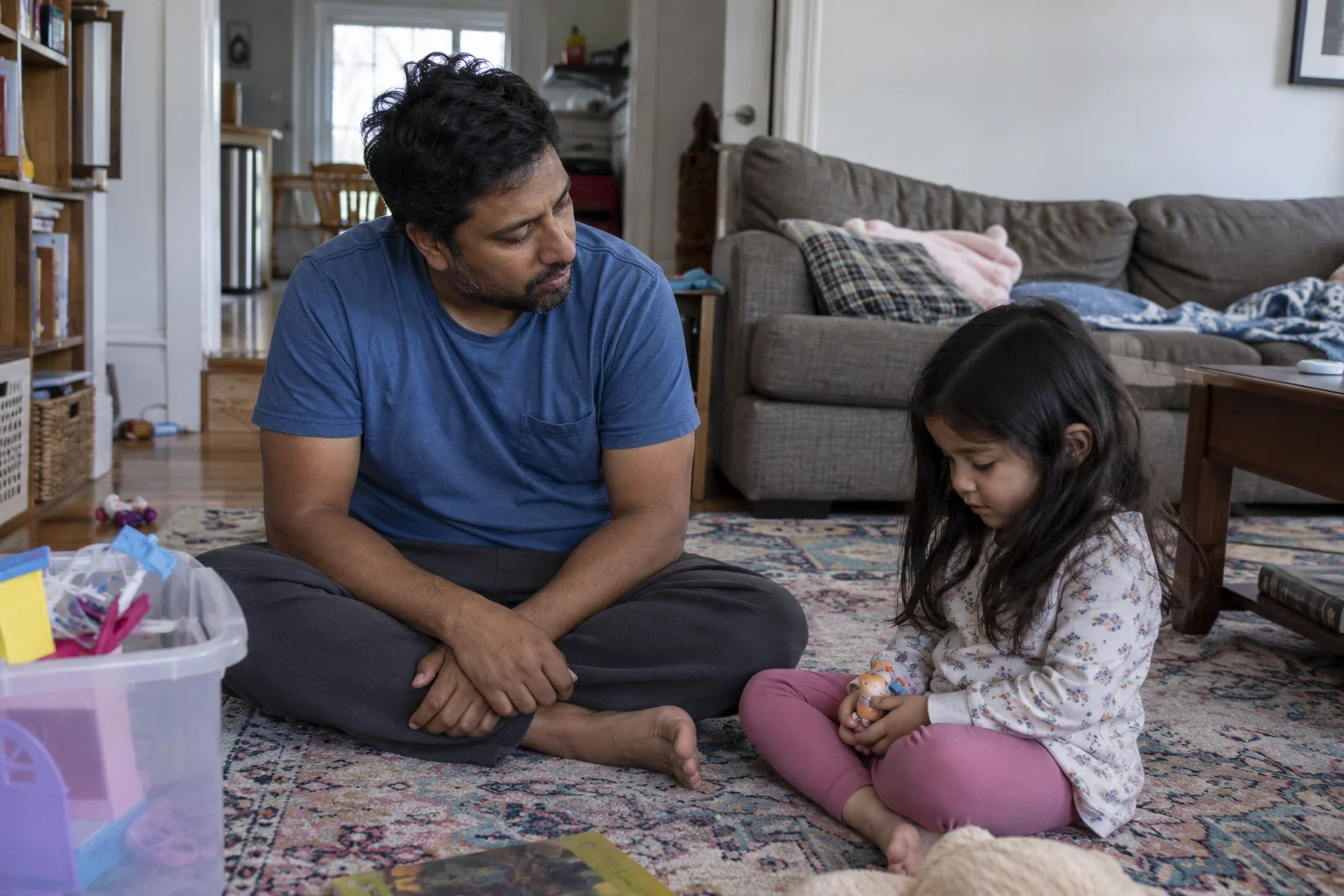
‘Because I said so. Stop arguing.’
You hear the sentence as you say it. The words, the tone, even the pause in the middle. You haven’t heard your father say it in years. Now you’ve said it to your own child.
Perhaps your version is ‘Stop crying.’ Or ‘Don’t be such a baby.’ A phrase you never planned to use, arriving in the middle of a difficult bedtime.
If you recognize an old parenting habit, begin with the specific thing you want to change. You can interrupt a sentence, put a limit into different words, and return to your child after getting it wrong. You do not have to settle every question about your own childhood first.
Familiar words are something to notice
Some things you picked up from your dad may be things you want to keep: the ridiculous voices at story time, the way he stopped to look at a beetle, the pancakes on Saturday. Other habits may sit badly with you now.
ZERO TO THREE encourages parents to reflect on which parts of their upbringing they want to repeat and which they would rather change. That does not require deciding that your childhood was entirely good or entirely bad.
It also does not mean every impatient response has a hidden childhood explanation. Sometimes you are exhausted and the milk has just gone under the refrigerator.
Stick with what you can observe: ‘When my child cries after I say no, I tell them to stop.’ That gives you a clearer place to begin than ‘I’m turning into my father.’
Choose one sentence before you need it
A new response is harder to invent when you are already angry. Pick one situation that comes up often and write down something you would rather say.
Instead of ‘Stop crying,’ you might try: ‘You’re upset. We’re still leaving the park.’
Instead of ‘Don’t be a baby,’ try: ‘Which part do you want help with?’
Instead of ‘Because I said so,’ when there is a simple reason: ‘I won’t let you climb there. That shelf could fall.’
Say your new sentence out loud once. If it feels unnatural, shorten it. ‘You wanted another turn’ may be easier to remember than a long explanation.
You can be brief and keep the boundary. Letting your child cry about a decision does not mean reversing the decision.
Catch the moment a little earlier
Think about the minute before the phrase comes out. Are you repeating instructions from another room? Trying to answer work messages while getting pajamas on? Already late?
In the Child Mind Institute’s guidance with child and adolescent psychiatrist Steven Dickstein, noticing recurring flashpoints is one way to prepare for them.
Your adjustment might be ordinary: put the phone down for the five minutes of getting dressed, bring the pajamas downstairs, or ask another adult to take over before you are shouting.
If you need a pause, keep your child safely supervised. You can say, ‘I’m getting too loud. I’m going to pause.’ A pause is for managing your response, not a threat to withdraw your affection.
What if you’ve already said it?
You can stop halfway through.
‘I don’t want to say that. Let me try again.’
If you have frightened or insulted your child, return when you can speak steadily. Keep the responsibility with you:
‘I told you to stop crying, and I shouted. That wasn’t okay. You were upset about leaving. Next time I’m going to help you put your shoes on without shouting.’
Avoid adding ‘but you wouldn’t listen.’ And you do not need your child to comfort you, forgive you immediately, or hear the full history of your relationship with their grandfather.
Our article on apologizing after yelling has more examples for that conversation.
Work on a response you can actually practice

The Child Mind Institute’s guidance on modeling coping skills recommends starting with one or two manageable ways of handling difficult feelings.
For you, that might mean setting your hands down on the counter before you speak. Or noticing the first sharp ‘Hey!’ and reducing your volume before the next sentence.
Try the replacement when things are going reasonably well too. If your child complains mildly about putting a toy away, that is a chance to practice before the bigger argument at bedtime.
You may still get it wrong. Look for a change you can describe: you noticed sooner, stopped before raising your voice, or came back to apologize without blaming your child.
When this needs support beyond a new phrase
If these moments bring up painful memories, or anger is becoming frequent and difficult to control, talk with a qualified mental health professional. ZERO TO THREE notes that reflecting on your upbringing can raise strong feelings and that professional support may help.
If you are worried you might hurt your child, arrange safe supervision with a trusted adult and seek urgent local professional help. Do not rely on a sentence swap when safety is at risk.
For an ordinary difficult evening, choose the next response you want to practice. ‘You can be upset. I won’t let you hit.’ ‘Let me try that again.’ Something short enough to remember when the milk is on the floor.
If your hardest moments happen when play has to end, start with our guide to helping a preschooler stop playing.
Sources and further reading
[1] ZERO TO THREE — The Past Is Present
[2] Child Mind Institute — Calm Voices, Calmer Kids
[3] Child Mind Institute — How to Model Healthy Coping Skills
General ideas for family life; seek individual professional advice for concerns about your child.